Biological Age Test: Is Your Body Aging Faster?

Is Your Body Aging Faster Than You Are? How to Measure Your Biological Age
Fall is nature's season of preparation. Trees drop their leaves, animals store energy, and everything gets ready for winter. Your body follows a similar rhythm, and the months ahead bring the heaviest eating stretch of the year: Halloween candy, Thanksgiving dinner, holiday parties, and New Year's celebrations.
That makes fall the perfect time to ask a simple question: is your body aging faster than you are? A biological age test can help you find out.
Key points
- Your biological age can be younger or older than your birthday says, and it can change.
- Phase angle shows how strong and healthy your cells are. Healthy adults usually score above about 6.
- The ECW ratio is a simple inflammation check. Most healthy people sit near 0.380.
- VO2 max is one of the strongest predictors of a long life. The least fit adults have about five times the risk of death of the fittest.
- Muscle strength predicts a long life better than muscle size. Grip strength is a quick, powerful test.
- Testing before the holidays gives you a baseline to compare against in January.
Biological age vs. chronological age
Your birthday tells you your chronological age, or calendar age. It can't tell you how old your cells, muscles, heart, and metabolism actually are. That is your biological age, and it can be younger or older than the number on your driver's license. The good news is that biological age can be measured, and it can change.
In our articles on fiber and the gut-brain connection, protein, digestion, and fasting, and why muscle protects your brain, we showed how each part of your health affects the others. Here, we answer the question that ties them together: how do you know where you actually stand? In this article, we cover:
- How an InBody scan works, and the two numbers that show how healthy and how inflamed your cells are
- How to measure biological age with a body scan and a breath test working together
- Grip strength vs. leg muscle, and why strength predicts a long life better than size
- The Longevity Assessment, our new way to get all your numbers before the holidays
How an InBody scan works
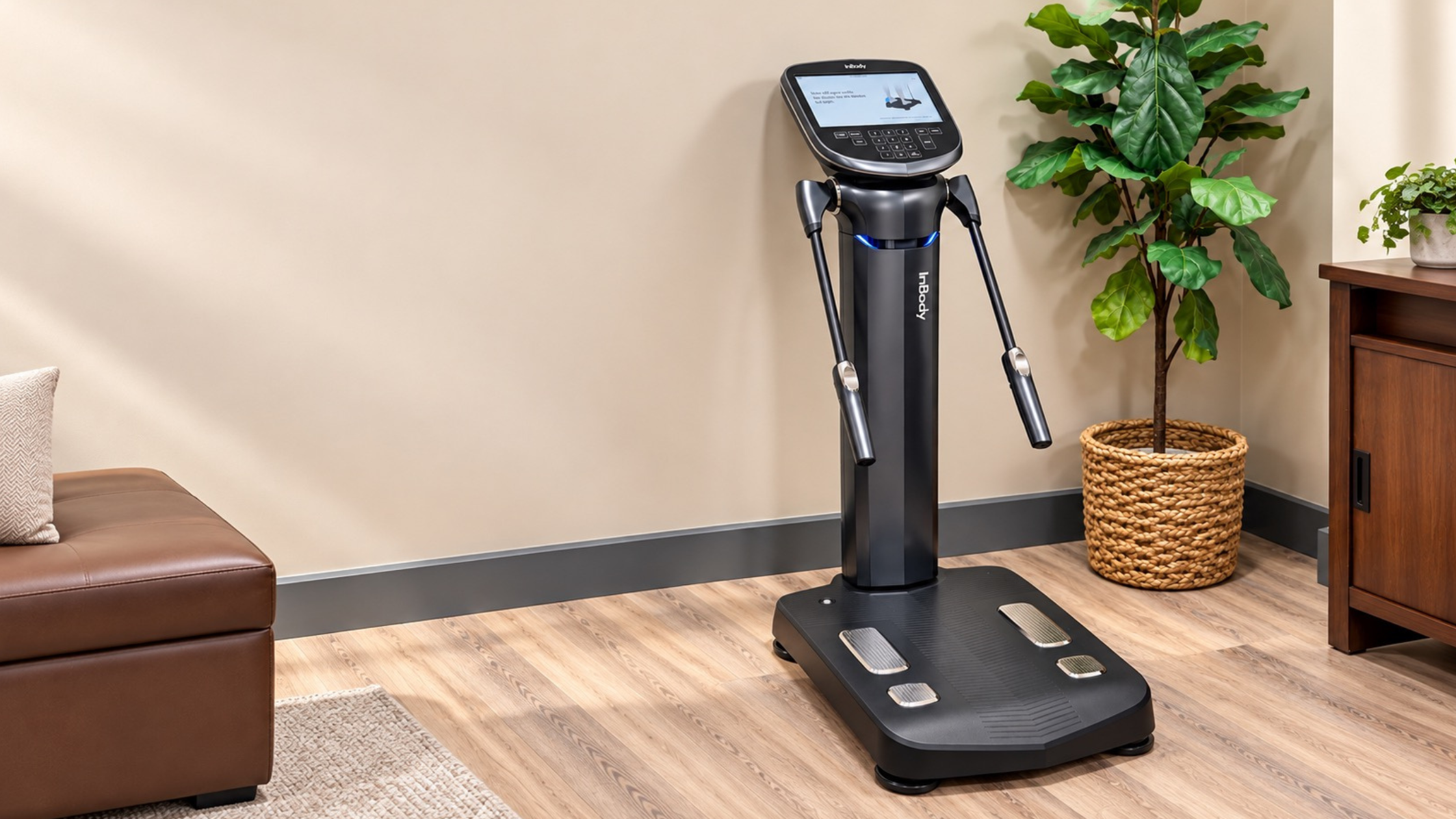
An InBody scan is a quick, painless body composition test. It sends tiny electrical signals through your body, each at a different speed, or frequency. Most people feel nothing at all.
Slow signals can't get through a healthy cell wall, so they travel around your cells through the water outside them. Fast signals pass straight through cell walls and reach the water inside. By comparing the two, the InBody measures your muscle, fat, and water in each arm, each leg, and your trunk.
The scan also measures how well your cells hold an electrical charge. Two of its results tell us the most about how your cells are aging: phase angle and the ECW ratio.
What is phase angle? Your cells' battery level
Every cell in your body is wrapped in a thin wall called a membrane. A healthy membrane works like a tiny battery. It holds an electrical charge and keeps the right things inside the cell and the wrong things out. If that charge is weak, the cells literally become leaky, like a boat with a hole in it, and need a lot of extra energy to stay afloat.
Your phase angle is the InBody's measure of how well your cells hold that charge.
- Higher phase angle means strong, healthy cells with good membranes and good nutrition. Healthy adults usually score above about 6.
- Lower phase angle means cells are weaker, leakier, or inflamed.
This is not just a fitness number. In a large review of seriously ill patients, those with a low phase angle were about two and a half times more likely to die than those in the normal range.
For healthy people, phase angle is an early warning light. It tends to drop with age, inactivity, poor sleep, gut problems, and inflammation. It tends to rise with strength training, better digestion, and good nutrition. That makes it one of the best numbers to track over a season, like this fall into winter.
What is the ECW ratio? A simple inflammation check
About half to two-thirds of your body is water. But where that water sits tells us a lot about your health.
Water inside vs. outside your cells
- Intracellular water (ICW) is the water inside your cells. Healthy muscle cells are packed with it. More ICW usually means more muscle and better-fed cells.
- Extracellular water (ECW) is the water outside your cells, in your blood, lymph, and the spaces between cells. You need it to carry oxygen, nutrients, and waste. But too much of it can mean swelling, inflammation, or cells that are leaking.
The ECW ratio is the share of your total body water that sits outside your cells. It is one of the most useful numbers on an InBody scan.
ECW ratio ranges: what your number means
- 0.360 to 0.380: Healthy balance. Lower numbers are common in fit, muscular people.
- 0.380 to 0.390: Still normal, but worth watching over time.
- 0.390 to 0.400: Slightly high. May point to swelling, inflammation, or loss of muscle quality.
- Over 0.400: High. Worth a conversation with your clinician.
InBody's own guides put the healthy range at 0.360 to 0.390, with most healthy people near 0.380. In a healthy adult, about 62% of body water is inside the cells and 38% is outside.
How phase angle and the ECW ratio change with age
As we age, two things tend to happen at once. Muscle cells shrink and hold less water, so ICW drops. And low-level inflammation pushes more water into the spaces between cells, so ECW rises. The result is an ECW ratio that slowly creeps up.
That is why the ECW ratio and phase angle work as a pair. Phase angle tells us how strong your cell walls are. The ECW ratio tells us where your water is sitting. When phase angle falls and the ECW ratio climbs, cells are getting weaker and leakier, often long before you feel it. When we fix the gut, calm inflammation, and rebuild muscle, we often see both numbers move back the right way.
How to measure biological age: two tests, one clearer picture
No single test can tell your exact biological age. But two quick tests, used together, give a strong estimate of how your body is aging, from your cells to your heart and lungs. The InBody scan shows what your body is made of. The PNOE breath test shows how your body runs.
PNOE estimates biological age by comparing your VO2 max with people your age. VO2 max is the most oxygen your body can use during hard exercise. Think of it as the size of your engine.
That matters, because aerobic fitness is one of the strongest predictors of how long people live. In a Cleveland Clinic study of more than 122,000 adults who had treadmill tests, people with the lowest fitness had about five times the risk of death of the fittest group, and the researchers found no upper limit to the benefit. Low fitness carried as much risk as smoking, diabetes, or heart disease.
PNOE breath test: how it reads your metabolism
You wear a mask while resting or exercising, and PNOE measures the oxygen you breathe in and the carbon dioxide you breathe out. Every cell in your body burns fuel using oxygen, the way a fire needs air, and gives off carbon dioxide. So the air you breathe out carries a record of how your cells are working. PNOE reads that record, breath by breath, in three ways:
- How much oxygen you use. More oxygen used means more energy being made. The highest amount you can use during hard exercise is your VO2 max.
- How much carbon dioxide you make. Burning fat and burning sugar give off different amounts of carbon dioxide for the same oxygen.
- The ratio between the two. This tells us which fuel you are burning. A ratio near 0.7 means your cells are running mostly on fat. A ratio near 1.0 means they are running mostly on sugar. A healthy, flexible metabolism shifts smoothly between the two.
During an exercise test, the intensity slowly climbs. PNOE tracks the point where your body burns the most fat, the point where it switches over to sugar, and the most oxygen it can use at the top. During a resting test, it measures how many calories you burn just to keep your body running.
Metabolic flexibility: what a breath test shows that a scale can't
Two people can weigh the same and have the same body fat but run on very different engines. One burns fat easily at rest and during a walk. The other runs on sugar all day, gets hungry every few hours, and stores fat easily. That second pattern is often called poor metabolic flexibility, and it is one of the earliest signs of metabolic aging. A breath test can show it years before blood sugar labs turn abnormal.
In all, PNOE measures 23 markers from your breath. Along with VO2 max and fat burning, two more are worth knowing:
- Resting metabolic rate: how many calories you burn at rest.
- Breathing patterns and nervous system signals: how calm or stressed your body runs.
InBody vs. PNOE: what each test shows
Each test catches what the other misses.
- Muscle. InBody shows how much you have and where. PNOE shows how well it burns fuel.
- Fat. InBody shows how much you have and where it sits. PNOE shows whether your body can burn it.
- Cells. InBody shows how healthy your cell membranes are (phase angle). PNOE shows how well your cells make energy.
- Heart and lungs. InBody does not measure these. PNOE measures your engine size (VO2 max).
- Metabolism. InBody estimates it from your muscle. PNOE measures it directly from your breath.
For example, someone may look healthy on the scale but have a low phase angle and poor fat burning. That person is aging faster than they look. Another person may carry extra weight but have good muscle, a strong VO2 max, and healthy cells. They are often in better shape than they think.
Together, these two tests take less than 30 minutes and give you a starting line. Repeat them a few months later, and you can see whether your biological age is moving in the right direction.
Grip strength and longevity: why strength beats size
Body composition and metabolism are two pieces of the picture. The third is strength. Muscle can be measured two ways: how strong it is and how much of it you have. They sound like the same thing, but they are not, and the difference matters for how you age.
Grip strength: a simple test with big predictive power
Grip strength is tested by squeezing a handheld gauge called a dynamometer. It takes about a minute, and it is one of the most powerful single predictors of long-term health we have.
- Survival. In the PURE study of nearly 140,000 adults in 17 countries, every 11 pounds (5 kg) of lost grip strength was linked to a 16% higher risk of death, and grip predicted death better than blood pressure.
- Brain health. In a UK study of more than 466,000 adults, people in the weakest fifth for grip strength had a 72% higher risk of developing dementia than those in the strongest fifth.
Grip is not just about your hands. It reflects how well your nerves and muscles work together across your whole body.
Muscle strength vs. muscle size
Here is the surprising part. In a study of more than 2,000 adults in their 70s, both leg strength and grip strength strongly predicted who lived longer, but muscle size did not. The researchers concluded that muscle quality matters more than muscle quantity. They also found that grip strength predicted risk about as well as leg strength.
In plain terms: big muscles that don't work well do not protect you. Strong, healthy muscle does. That is exactly why we pair grip strength with phase angle and the ECW ratio. Together, they show the quality of your muscle, not just the amount.
Leg muscle: where muscle loss shows up first
Your legs hold the largest muscles in your body, and they are often the first to shrink when activity drops. The InBody measures muscle in each leg separately, so we can see loss early, or spot one side weaker than the other.
Leg strength also connects to the brain. In a 10-year study of 324 twin sisters, the twin with more leg power at the start kept sharper thinking and more brain tissue a decade later, even though twins share the same genes and upbringing.
How doctors define muscle loss (sarcopenia)
The European working group on age-related muscle loss, called sarcopenia, looks at strength first, then muscle amount, to make the call. Their 2019 cutoffs are:
- Low grip strength: under 27 kg (about 60 lb) for men, and under 16 kg (about 35 lb) for women.
- Low arm and leg muscle for your height: under 7.0 kg/m² for men, and under 5.5 kg/m² for women.
These are the lines for a diagnosis. We don't wait for them. Watching your numbers drift toward them years earlier gives you time to act.
Reading grip strength and leg muscle together
- Strong grip, healthy leg muscle: You are aging well. Keep doing what you are doing.
- Weak grip, healthy leg muscle: The muscle is there, but its quality is slipping. Check phase angle, inflammation, and nerves.
- Strong grip, shrinking leg muscle: Early muscle loss in the legs. Time to train and check protein digestion.
- Weak grip, shrinking leg muscle: Muscle loss is underway. This is the most important pattern to address now.
Each of these numbers tells part of the story. Measured together, they show how fast your body is really aging. That is exactly what our new Longevity Assessment is built to do.
Coming soon: the Longevity Assessment
Fiber, digestion, protein, muscle, and cell health are all connected, and each one can be measured. The Longevity Assessment puts all of those measurements together in one visit at our Brentwood, Tennessee clinic.
Think of it as a look under the hood. It uses the same in-depth testing we use in our NeuroCellular program, without committing you to a full treatment program.
What the Longevity Assessment measures
- InBody scan: muscle in each arm and leg, body fat, hidden belly fat, phase angle, and your ECW ratio
- PNOE breath test: VO2 max, resting metabolism, fat burning, fuel flexibility, and an estimate of biological age (learn more about VO2 max testing)
- Grip strength: one of the strongest single predictors of long-term health and brain aging
- Gut and metabolic testing: what is driving your numbers, from digestion to cell energy
What you walk away with
- Your numbers, explained in plain language. Not just a printout, but what each result means for you.
- Where you stand. How your cells, muscle, and metabolism compare with healthy ranges for your age.
- Your top priorities. The few changes most likely to move your numbers, so you are not guessing.
- A baseline to measure against. Retest later and see exactly what changed.
From there, you can take your results and run with them, or work with us if you want help.
Who the Longevity Assessment is for
- Adults who want to know how they are really aging, not just what their birthday says
- People who feel "off" but have been told their labs are normal
- Anyone who has tried diets, supplements, or high-protein plans without clear results
- Active adults and athletes who want hard data to guide training and nutrition
Why get a baseline before the holidays
The holidays are about to test every system we have talked about. A baseline taken before Thanksgiving lets you see in January exactly how your body handled the season: whether you held your muscle, whether inflammation crept up, and whether your metabolism stayed flexible.
Frequently asked questions about biological age testing
What is biological age?
Biological age is how old your body acts on the inside, based on the health of your cells, muscles, heart, and metabolism. Your chronological age is simply how many birthdays you've had. The two can be different, and unlike your birthday, your biological age can change.
How do you measure biological age?
No single test gives an exact number, but two tests together give a strong estimate. An InBody scan shows your muscle, fat, water balance, and phase angle. A PNOE breath test measures your VO2 max and how well you burn fuel. PNOE estimates biological age by comparing your VO2 max with people your age.
Can you lower your biological age?
Many of the numbers behind it can improve. Phase angle tends to rise with strength training, better digestion, and good nutrition. When we fix the gut, calm inflammation, and rebuild muscle, we often see phase angle and the ECW ratio move back the right way. Retesting a few months later shows whether you are on track.
What is a good phase angle?
Healthy adults usually score above about 6. A higher phase angle means stronger, healthier cells. A lower score can point to cells that are weaker, leakier, or inflamed. Phase angle tends to drop with age, inactivity, poor sleep, gut problems, and inflammation.
What is a normal ECW ratio on an InBody scan?
InBody's guides put the healthy range at 0.360 to 0.390, with most healthy people near 0.380. A ratio from 0.390 to 0.400 is slightly high and may point to swelling, inflammation, or loss of muscle quality. A ratio over 0.400 is worth a conversation with your clinician.
Is an InBody scan safe?
Yes. The scan sends tiny, painless electrical signals through your body, and most people feel nothing at all. If you have a pacemaker or another implanted medical device, or you are pregnant, let us know before your visit.
What happens during a PNOE breath test?
You wear a mask while resting or exercising. It measures the oxygen you breathe in and the carbon dioxide you breathe out. During an exercise test, the intensity slowly climbs so PNOE can find where you burn the most fat, where you switch to sugar, and your VO2 max.
Why is grip strength linked to longevity?
Grip strength reflects how well your nerves and muscles work together across your whole body. In a study of nearly 140,000 adults, every 11 pounds of lost grip strength was linked to a 16% higher risk of death. Weak grip has also been linked to a higher risk of dementia.
How long do the tests take, and how often should I retest?
The InBody scan and PNOE breath test together take less than 30 minutes. Retesting a few months later shows what changed. A baseline before the holidays and a retest in January shows how your body handled the season.
This article is for education only and does not replace personal medical advice. Talk with your clinician before changing your diet or exercise routine.
Sources
- Zheng et al., phase angle and survival review, Frontiers in Medicine (2023)
- InBody, result sheet interpretation: ECW/TBW ratio
- InBody, body water balance and the ECW ratio
- PNOE, FAQ on biomarkers and biological age
- Mandsager et al., cardiorespiratory fitness and long-term mortality, JAMA Network Open (2018), via TCTMD
- Leong et al., PURE grip strength study, The Lancet (2015), via NEJM Journal Watch
- Esteban-Cornejo et al., grip strength and dementia, UK Biobank, Journal of Cachexia, Sarcopenia and Muscle (2022)
- Newman et al., strength, but not muscle mass, and mortality, Journals of Gerontology (2006)
- Steves et al., leg power and brain aging in twins, Gerontology (2016)
- EWGSOP2 sarcopenia cutoffs, summarized in Journal of Cachexia, Sarcopenia and Muscle (2023)

Dr. Justin Dearing
Ready to feel like you again?
* Your next step toward feeling better starts today. At The Dearing Clinic we make it simple to get started with care that truly fits your life. Book your visit now and let’s design a plan that restores your energy, relieves your pain, and helps you enjoy more of what matters most.