
'Tis the Season: School Is Back And Strep Came Out Swinging
Dr. Justin Dearing of The Dearing Clinic explains how strep's immune response can silently damage the heart and, as newer research shows, the brain — driving conditions from rheumatic heart disease to unexplained adult anxiety and brain fog. He outlines his two-track approach: immediate antibiotics for a positive test, herbal antiviral support for a negative one, plus an antifungal strategy to run alongside antibiotics. The post closes with a list of go-to plants and clear safety warnings against self-dosing.

'TIS THE SEASON: School Is Back And Strep Came Out Swinging
Key Points
- Strep throat itself clears up in about a week either way — the antibiotic isn't really treating the sore throat, it's cutting the infection short before the immune system "turns its weapons" on the body's own tissue (molecular mimicry)
- If the swab is positive, treat with antibiotics immediately — no herbal remedy replaces this
- If the swab is negative, don't use antibiotics (they don't touch viruses) — start antiviral/antimicrobial plant support instead
- Strep bacteria resemble proteins in the heart and brain, so antibodies built to fight strep can attack those tissues too
- Untreated/repeated strep can lead to rheumatic heart disease — valve damage that worsens with each subsequent infection, not just repeats the same damage
- ~55 million people worldwide live with rheumatic heart disease; it's rare in the U.S. specifically because of fast testing and treatment
- Newer research shows a similar mechanism reaching the brain: immune cells trained in the tonsils/adenoids travel via the olfactory nerve pathway into the brain, loosening the blood-brain barrier
- The Neural Zoomer Plus antibody panel checks for markers like anti-dopamine receptor (D1/D2), anti-tubulin, anti-RAGE, and anti-CASPR — patterns the author links to treatment-resistant anxiety and brain fog in adults with no memory of having strep
- Antibody evidence reflects lifetime exposure to strep, not necessarily a remembered diagnosis
- Protocol during antibiotics: spore-forming probiotics (survive the antibiotic) plus antifungal herbal support (like Coptis) to prevent yeast overgrowth in the gap left by killed bacteria — then rebuild bacterial flora immediately after the course ends
- Historical framing: 16th-century Indigenous knowledge of an antiscorbutic tea (later understood as vitamin C) was lost and took ~200 years to rediscover — used as an analogy for herbal knowledge being sidelined by modern medicine
- Featured plants: Coptis (golden thread), Isatis (woad), Scutellaria (Chinese skullcap), Japanese knotweed, Houttuynia, Rosemary
- Safety caution: many of these herbs thin blood, affect blood pressure/sugar, interact with antidepressants, and are off-limits in pregnancy/nursing — dosing should be clinically supervised
Strep is already running hard through the schools this year, and I want to explain why I take it more seriously than almost anything else in a family's winter.
When one of my own kids has a fever, a red throat and sore glands, we do not wait. We get them swabbed, and if it comes back positive we want the antibiotic started that day. Let me be clear about what I am and am not saying. I do not prescribe antibiotics, and we do not test or treat strep at my clinic. That is a job for their physician and it should be. This is me as a parent, and it is the one situation where I want the prescription in hand immediately.
If the swab is negative, we do not give our child an antibiotic anyway, because an antibiotic does nothing at all to a virus. That is the day we start aggressive plant medicine instead. Both branches matter, and most families only ever get told about the first one.
Most germs cause trouble while they are in your body and then they leave. Strep can leave something behind, and that is the actual problem. The sore throat clears up in about a week whether you treat it or not, so the antibiotic is not really for the throat. It is to cut the infection short so the immune system never gets far enough into the fight to turn its weapons on you.
What It Does To The Heart
Strep bacteria wear a disguise. The proteins and sugars on their outer surface look a great deal like proteins in your own heart and brain, so when your immune system builds weapons against the invader, those weapons fit your own tissue just as well. Researchers call this molecular mimicry, and it explains everything else in this article.
Your heart valves open and close about 100,000 times a day, and most people have never heard that a healthy valve has no blood supply of its own. Immune cells are not supposed to be able to get into one at all.
Strep gets around that in two steps. The antibodies your body built against the bacteria land on the valve surface, because that surface resembles the bacteria closely enough to fool them, and when they land they flip a switch that opens a door where there was never a door before. Immune cells walk through that door into the valve and begin attacking it. Inflammation sets in and the valve scars, so it either stiffens and cannot open fully or warps and no longer seals. The heart works against that defect every beat for the rest of that person's life, and some need valve replacement surgery. That is rheumatic heart disease.
It gets worse with each round, not the same.
In laboratory studies, every new exposure produced a stronger immune reaction against heart tissue than the one before it, with more damage in the valve each time. Five strep infections in a childhood are not five separate illnesses that each resolve. They are one process building on itself five times over.
About 55 million people worldwide live with rheumatic heart disease, but it is genuinely uncommon in the United States, and for one reason: we test quickly and we treat quickly. The countries where it is common are the ones where strep throat goes untested. That is not an argument for relaxing. It is the argument for exactly what I described at the top of this article.
What It Does To The Brain
The heart side has been understood for decades. The brain side is newer, and it is where I spend most of my clinical time, because the people carrying it are adults and nobody has ever told them what happened.
Doctors could find antibodies in the blood that matched brain tissue after strep infections, but the brain sits behind a protective wall whose entire job is keeping things like that out, so the puzzle was how. Researchers eventually traced the route. When strep infects the throat and nose repeatedly, it trains a specific population of immune cells in the tonsil and adenoid tissue, and those cells travel from the nose into the brain along the nerve pathway used for smell. Once there, they loosen the protective wall and the antibodies follow them in. The brain's housekeeping cells switch into an inflamed state and some connections between brain cells are lost.
There were no bacteria in the brain in any of this work. The infection stayed in the throat the whole time. What reached the brain was the immune response, not the germ. And once again, the trigger was repeated infection rather than a single one.
What The Neural Zoomer Shows Me
The Neural Zoomer Plus is an antibody panel. It does not measure symptoms or brain waves. It measures whether your immune system is producing antibodies against specific structures in your own nervous system.
Anti-dopamine receptor D1 and D2. These come up constantly in my adult patients with severe, treatment-resistant anxiety. Constantly. Dopamine receptors sit in the deep brain circuits handling motivation, threat detection, and the ability to stop a thought once it starts, and they are one of the documented targets that strep antibodies cross-react with. When someone has antibodies parked on those receptors, telling them to manage their stress better is not treatment.
Anti-tubulin. Tubulin is the internal scaffolding inside your nerve cells, and brain tubulin is the other well-documented strep cross-reaction target, sitting right alongside the heart protein described above. Same mimicry, different organ.
Anti-RAGE and anti-CASPR. RAGE is involved in inflammation and in the integrity of that protective wall around the brain, so elevation there tells me the wall itself is part of the problem, not just what is on the far side of it. CASPR proteins sit at the junctions along nerve fibers that let signals travel fast and clean, and antibodies there point to disrupted signaling.
The combination is what makes this useful. When elevated strep antibodies sit next to two or three of these neural markers, I am no longer guessing at a mechanism. I am looking at it.
Here is the part that surprises people most. What those antibodies suggest is a long history of exposure to strep, and exposure is not the same thing as a history of diagnosed infections. You can be exposed again and again, carry the organism quietly in your own throat, or live alongside someone who does, and never once be sick enough that anyone swabbed you. The immune system keeps its record either way.
So some of these patients had constant sore throats growing up or had their tonsils out, and they make the connection the moment I explain it. Plenty of others have no such history and are genuinely puzzled. They are usually in their thirties, forties and fifties, with brain fog that will not lift, anxiety that feels physical rather than situational, and a nervous system stuck in high alert. Nobody ever connected any of it to strep, because on the surface there was nothing to connect it to.
What I Do Alongside An Antibiotic, And What I Do Not
When someone in my practice is on a course of antibiotics their physician prescribed, this is what I have them run alongside it.
An antibiotic does not aim. It clears the strep and a great deal of your normal, useful bacteria with it, leaving open ground in your gut and on your mucous membranes. Something is going to move into that space.
Here is where I part ways with much of my own field. The standard advice is to take a probiotic during the course. Most common probiotic strains are ordinary bacteria, so the antibiotic kills them exactly as it killed everything else, and you are paying for organisms that do not survive long enough to colonize anything. There is one real exception: spore-forming probiotics travel in a protective shell, are not damaged by antibacterial drugs, and actually arrive intact.
But fungus is what actually moves in. Yeast is untouched by antibacterial drugs. It sits through the entire course with no competition and expands into the ground your bacteria just lost. This is why so many people finish antibiotics and develop yeast problems, bloating, sugar cravings or brain fog that were not there before, and why women so often get a yeast infection right afterward.
So my approach is the reverse of the common one. During the antibiotic, run antifungal support, defending empty ground from the organism actually able to take it. Coptis, the root known as golden thread, is my usual choice, because it covers fungus and bacteria at once and breaks up biofilm. Then, immediately after the course finishes, rebuild the bacteria, because that is when live organisms have a real chance. That timing is most of the difference between a supplement that works and one that just costs money.
When The Test Comes Back Negative
Your kid has a miserable sore throat, you do the right thing and get them swabbed, and it comes back negative. That is the most likely outcome, because most sore throats are viral. Colds, flu, mono and a handful of others account for far more of them than strep does. Then you hear that it is viral, there is nothing for that, rest and fluids.
The antibiotic is not the villain here. Antibiotics are one of the great achievements in the history of medicine. But one was never designed to touch a virus and never will, and that is not a failure of the drug. It is the edge of what the drug does, and the failure is that we arrived at that edge and decided there was nothing on the other side of it.
The Knowledge We Threw Away
In the winter of 1535, Jacques Cartier's crew was frozen in on the St. Lawrence River and dying of scurvy, with twenty-five men already dead. The St. Lawrence Iroquois showed them how to boil the bark and winter needles of an evergreen, most often identified since as white cedar, and make a tea from it. The men who drank it recovered within days. Europe was impressed enough to name the tree arbor vitae, the tree of life, and ship it home to plant in gardens.
Then it forgot what the tree was for. When Samuel de Champlain returned to the same stretch of river about seventy years later and went looking for the remedy, he could not find it. It took roughly two more centuries for medicine to work its way back around to vitamin C. The knowledge was not disproven and it was not replaced by something better. It was set down and not picked back up, and people suffered in the gap.
We are standing in a version of that gap right now. Elderberry has been used against winter respiratory illness for as long as we have written records of medicine, and it has real antiviral activity against influenza strains. Nettle and chickweed were common winter tonics on this continent and in Europe, both carrying anti-inflammatory and antimicrobial properties. Reishi mushroom has been used in Chinese medicine for two thousand years and turns out to stabilize the cells that drive histamine reactions. That is not folklore that got lucky. It is knowledge built by people who had no other options and therefore paid very close attention.
Modern medicine did not defeat that knowledge. It got busy with something that worked spectacularly well for bacteria and let the rest fall out of the curriculum. Now we have clinicians who handle strep brilliantly and nothing to offer for the eight viral illnesses a child gets in between. That has to be relearned, because every illness we cannot shorten or prevent is another turn of a wheel we now know damages nervous tissue when it turns often enough.
The Plants I Reach For
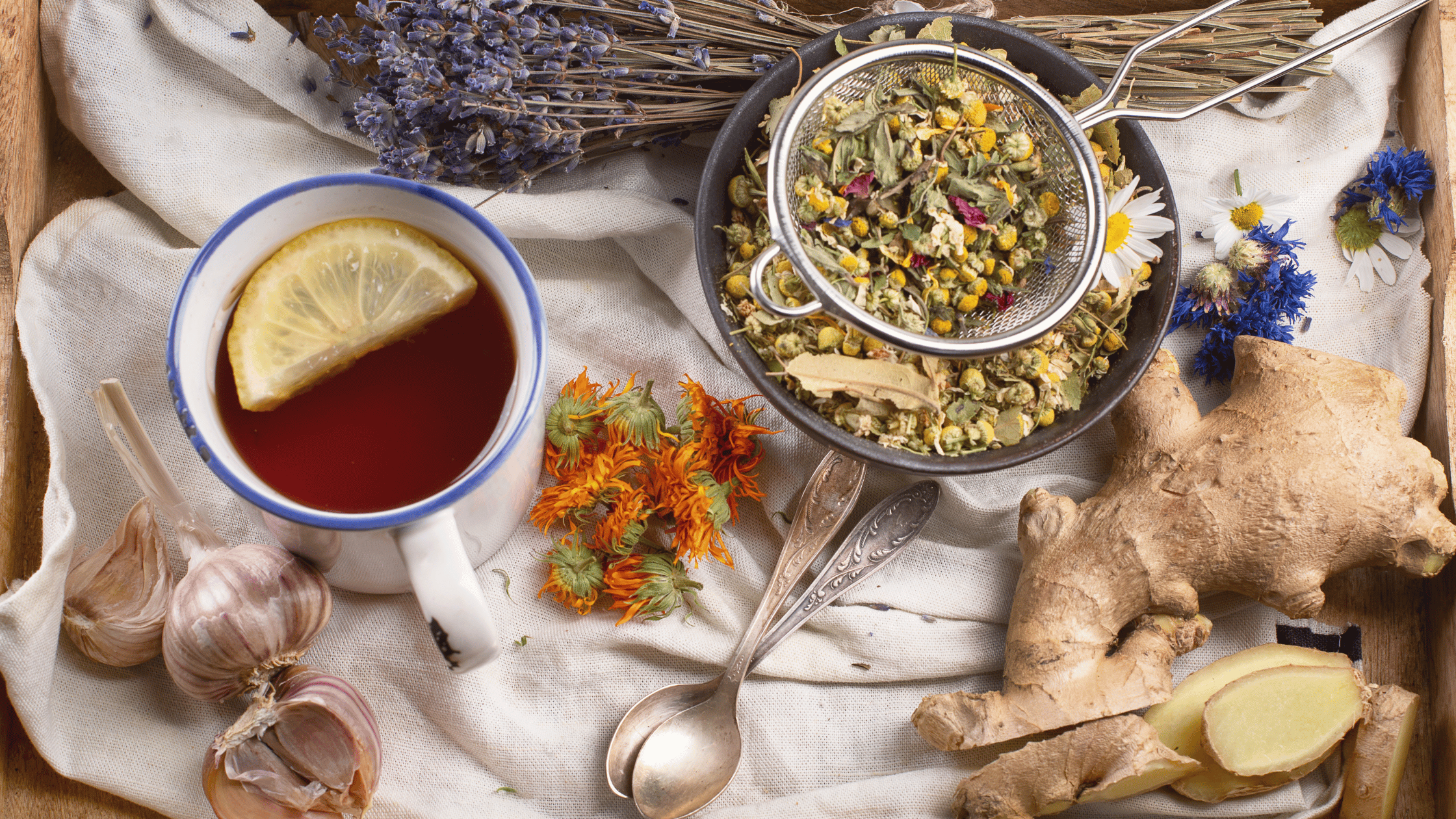
Golden thread (Coptis): Broad antibacterial including a named strep species, plus antiviral and antifungal, and it breaks up biofilm, the protective slime bacteria hide under
Woad (Isatis): One of the strongest antivirals available, used for centuries for tonsil and sinus infections, strongly anti-inflammatory
Chinese skullcap (Scutellaria): Antibacterial, antiviral and antifungal, raises glutathione, and supports the regulating arm of immunity whose job is knowing when to stand down
Japanese knotweed: Antiviral including influenza and Epstein Barr, breaks up biofilm, protective for the brain
Houttuynia: Antiviral across a wide range of viruses, calms allergy-type reactions
Rosemary: Named activity against the exact strep species that causes strep throat, specifically its biofilm
Notice how many cover fungus alongside bacteria and viruses, a range no single prescription can match, and how many work on the immune response rather than only on the germ. For the family that catches everything, a plan through the school year changes how often you are in this situation at all, and fewer infections is the entire goal.
Read This Before You Order Anything
These are not harmless because they are plants. Several thin the blood, and stacking three or more creates a bleeding risk no individual label warns you about. Some lower blood pressure, some lower blood sugar meaningfully, and some interact with antidepressants. Nearly the entire category is off limits during pregnancy and nursing. Which plant, at what dose, for how long, and alongside what else you are taking are clinical decisions, not website orders.
Where This Leaves You
If the swab is positive, take the antibiotic. Everything above is an argument for treating strep fast, not against it. No plant replaces antibiotics for a confirmed strep infection, and anyone telling you otherwise has not read what happens to heart valves. If it is negative, you are only out of prescription options, which is a far smaller category than people assume. Strep is not just a sore throat. It is an immune event that starts in the throat and does not necessarily stay there.
And if you are an adult with brain fog, physical anxiety, or a nervous system that never settles, that connection is testable, whether or not you remember a single case of strep in your life. Start with a New Patient Consultation. We will look at whether your immune system is still producing antibodies against your own nervous system, and what it will take to settle it down.
Frequently Asked Questions
1. Does this article recommend skipping antibiotics for strep?
No. Dr. Dearing is explicit that a positive strep test should be treated with antibiotics right away — the herbal information applies to supporting the body during and after treatment, or when a test comes back negative.
2. Can herbs replace an antibiotic for confirmed strep?
No. The article states plainly that no plant remedy replaces antibiotics for confirmed strep, given the heart valve risks of untreated infection.
3. Why give a probiotic during antibiotics if the antibiotic just kills it too?
Most common probiotic strains are ordinary bacteria that get killed right along with everything else. The article recommends spore-forming probiotics instead, since their protective shell lets them survive the antibiotic course.
4. What is the Neural Zoomer Plus?
An antibody blood panel that checks whether the immune system is producing antibodies against specific nervous system structures — not a symptom or brain-wave test.
5. Can someone have this antibody pattern without ever having had a diagnosed strep infection?
Yes. The article notes antibodies reflect cumulative exposure to strep, which can happen without ever being sick enough to get swabbed.
6. Is this treatment offered directly at The Dearing Clinic?
The clinic doesn't test or treat strep itself (that's a physician's job) - but does offer a New Patient Consultation for adults with symptoms like brain fog or physical anxiety who want to check for a strep antibody connection.
7. Are the herbal remedies safe to combine or self-dose?
No — the article specifically warns that several thin the blood, and combining multiple can create bleeding risk, plus interactions with blood pressure, blood sugar, and antidepressant medications. Dosing is described as a clinical decision.

Dr. Justin Dearing
Ready to feel like you again?
* Your next step toward feeling better starts today. At The Dearing Clinic we make it simple to get started with care that truly fits your life. Book your visit now and let’s design a plan that restores your energy, relieves your pain, and helps you enjoy more of what matters most.